Animal Control Software: A Guided Tour of Calls, Cases, Citations and Ordinances
Pet Friend Team · Updated August 3, 2026 · 9 min read
Most software sold to animal control is shelter software with an “officer” tab bolted on. This is a screen-by-screen tour of what Pet Friend's animal control module actually does — the ordinance library, citations that carry several ordinances at once, calls that become cases, bite reports for animals you've never impounded, and getting the offender's signature and receipt without a second trip. Every screenshot below is the real product.
Start with your ordinance library
Before an officer writes a citation, the agency writes its ordinances down — once. Each entry holds the municipal code, the plain-language description the offender will read, the standard fine, and the wording your agency always uses for that violation.
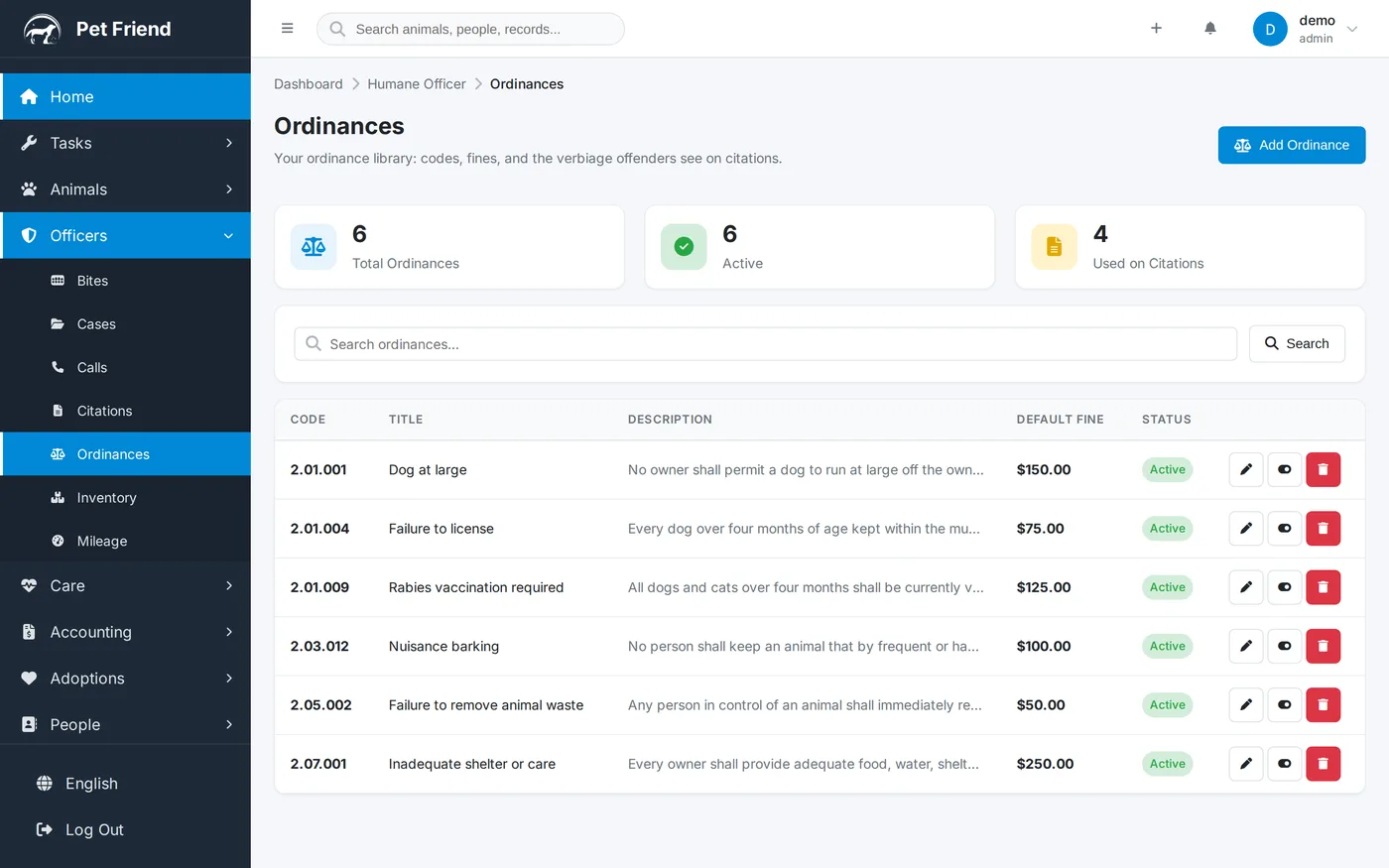
That last point matters more than it sounds. When an ordinance is deactivated or its fine changes next budget year, every citation already written keeps its own copy of exactly what it was issued under. Your historical records don't quietly rewrite themselves.
A citation that carries every violation
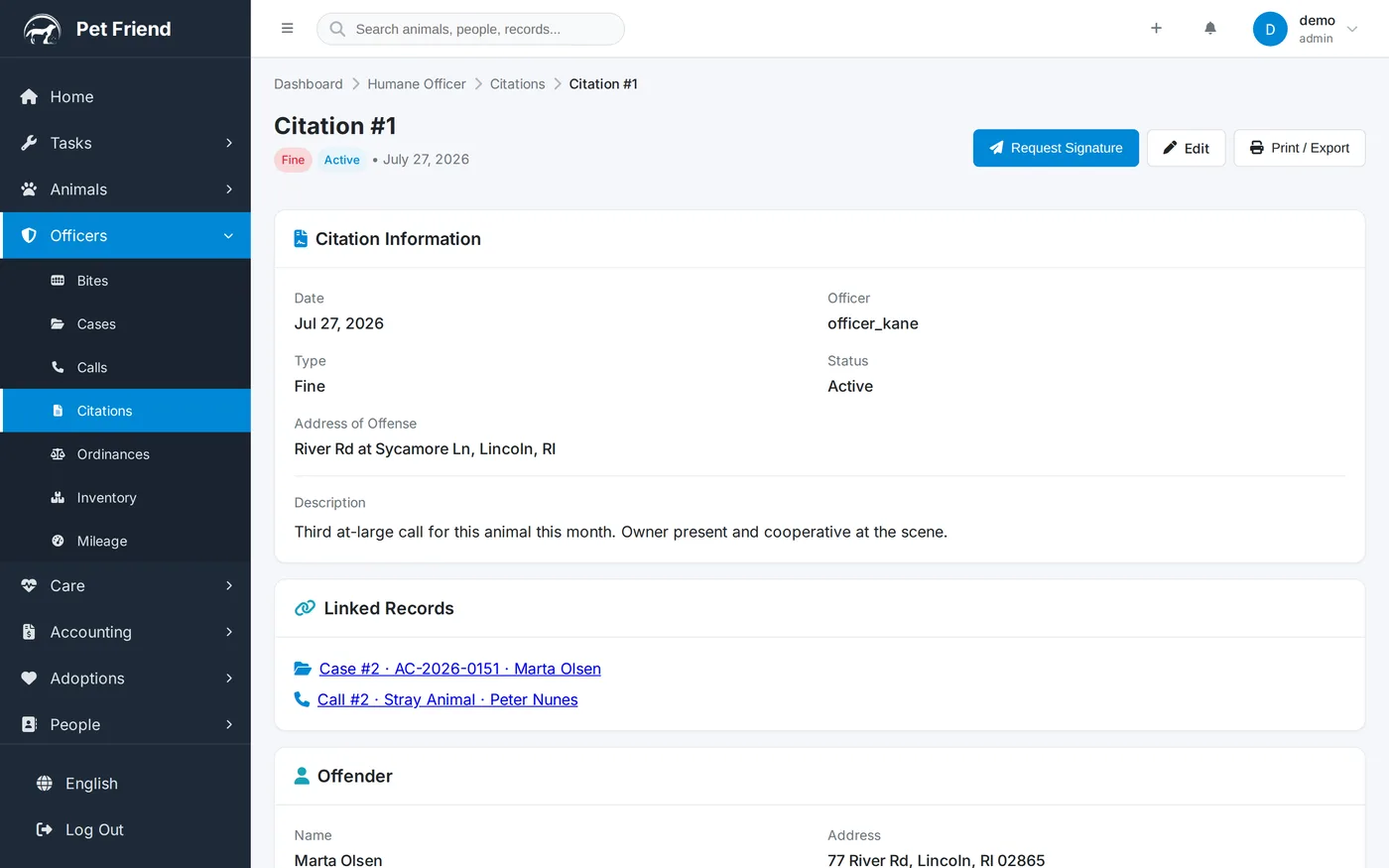
One call often produces several violations at once — the dog was at large, unlicensed, and its rabies vaccination had lapsed. Rather than three citations for one incident, the officer adds each ordinance to a single citation. Each one brings its own fine and its own wording, both editable for this specific call, and the total adds itself up.
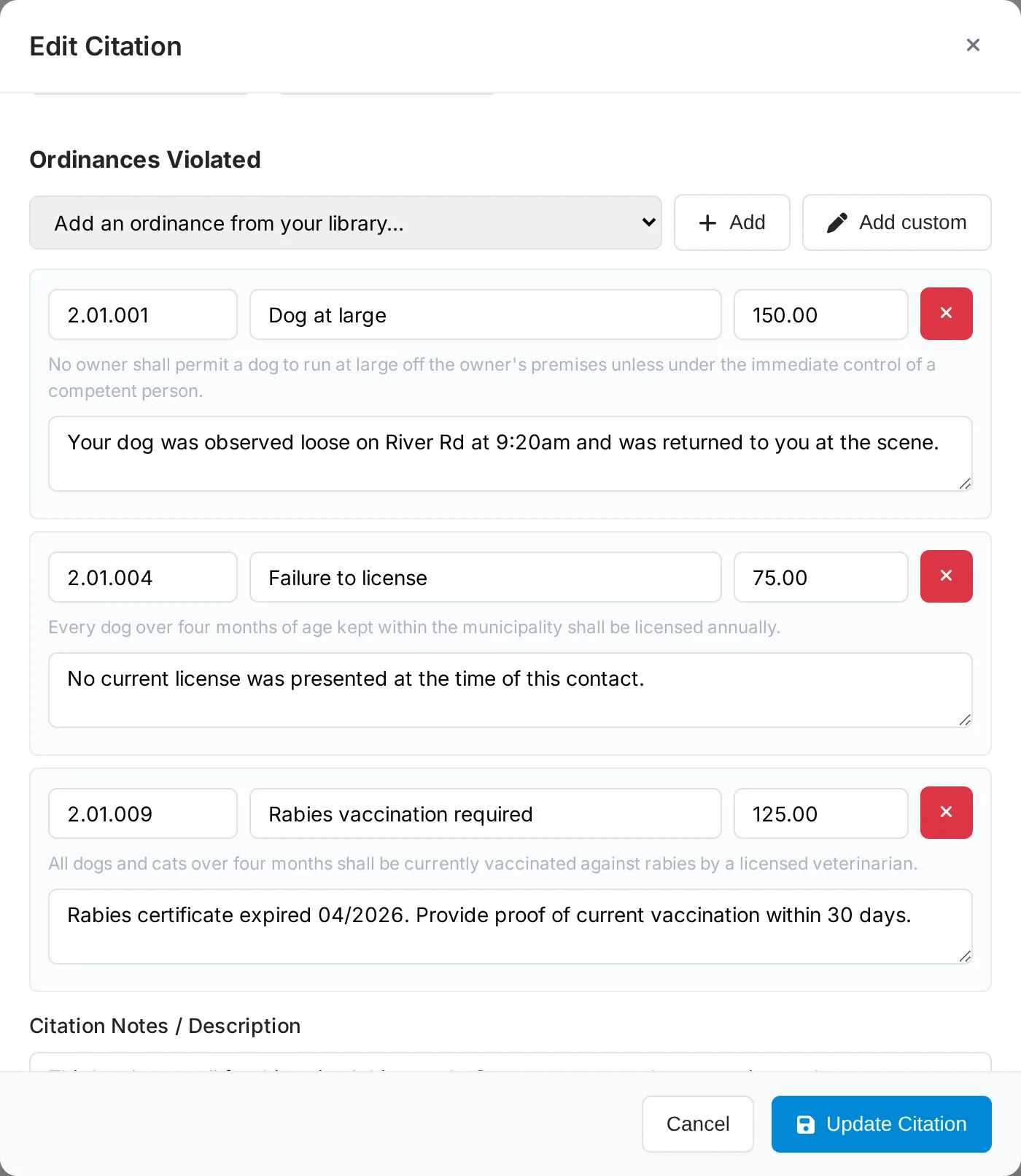
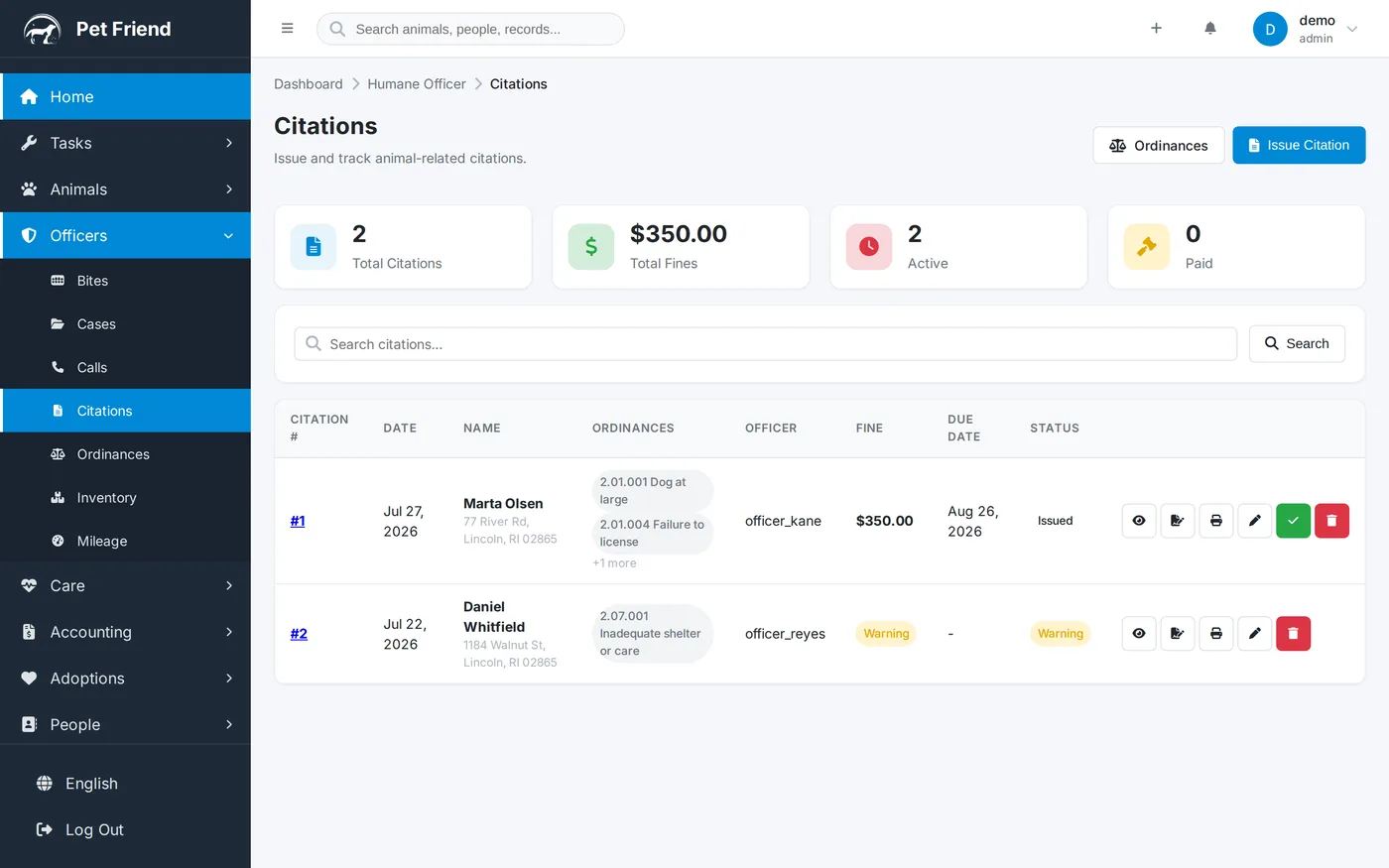
Offender details are recorded properly too: first, middle, and last name as separate fields, their address, driver's licence, and their email and mobile number — plus the address of the offense, which frequently is not where the offender lives. Warning and fine are separate checkboxes, so a warning notice reads as a warning rather than an unpaid bill.
Remote signature: the part officers actually notice
The traditional acknowledgment assumes the owner is standing in front of you and willing to sign. Often they aren't. Pet Friend builds the notice for you and sends it to the person — by email or text — or you hand over your own device and they sign on the spot.
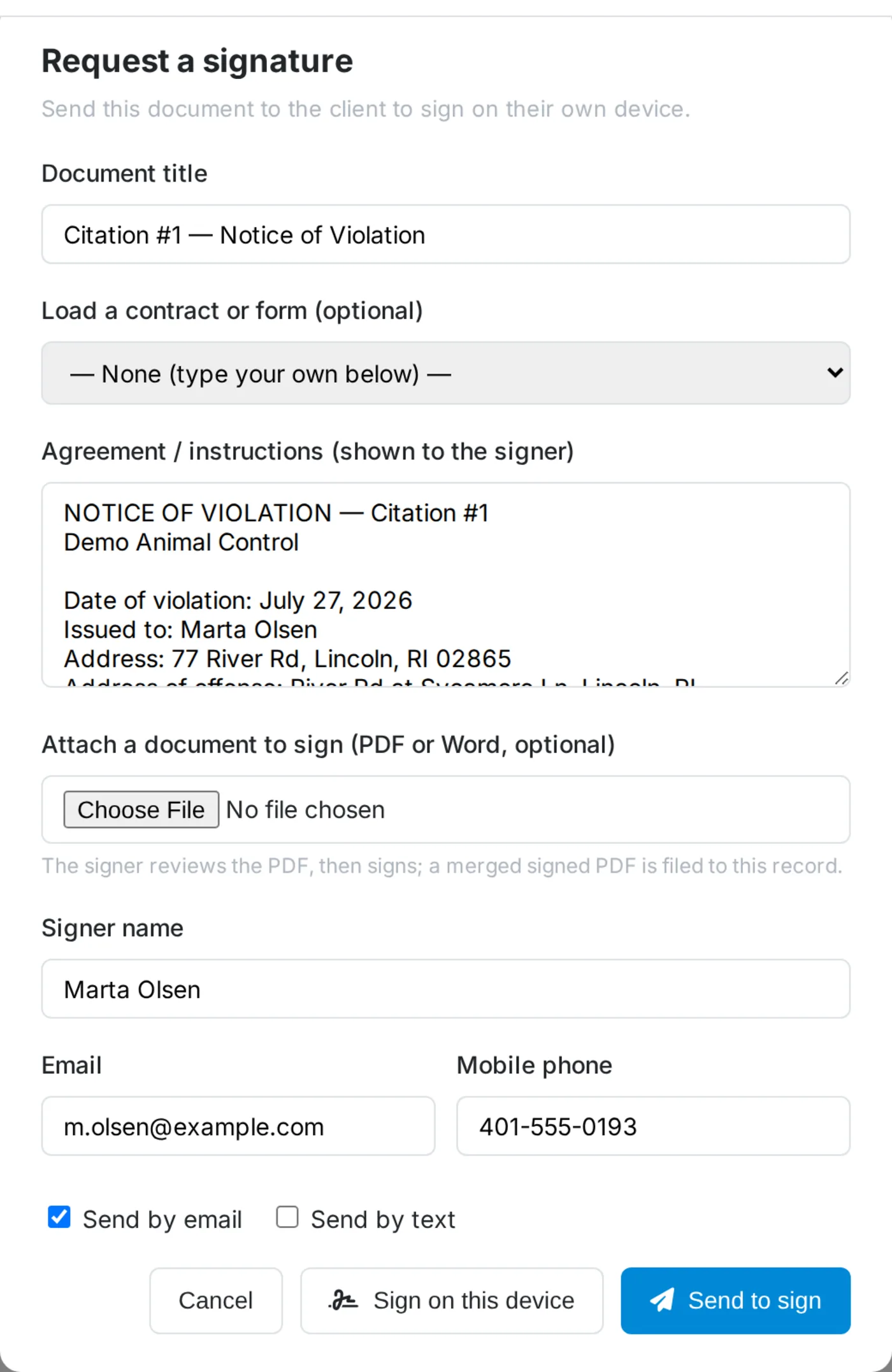
When they sign, they are sent a receipt automatically with a link to download their signed copy, and the signing link itself becomes their receipt page. Staff can resend it any time. When the fine is later marked paid, the offender gets a payment receipt itemized by ordinance — which removes the “I never got anything” conversation almost entirely.
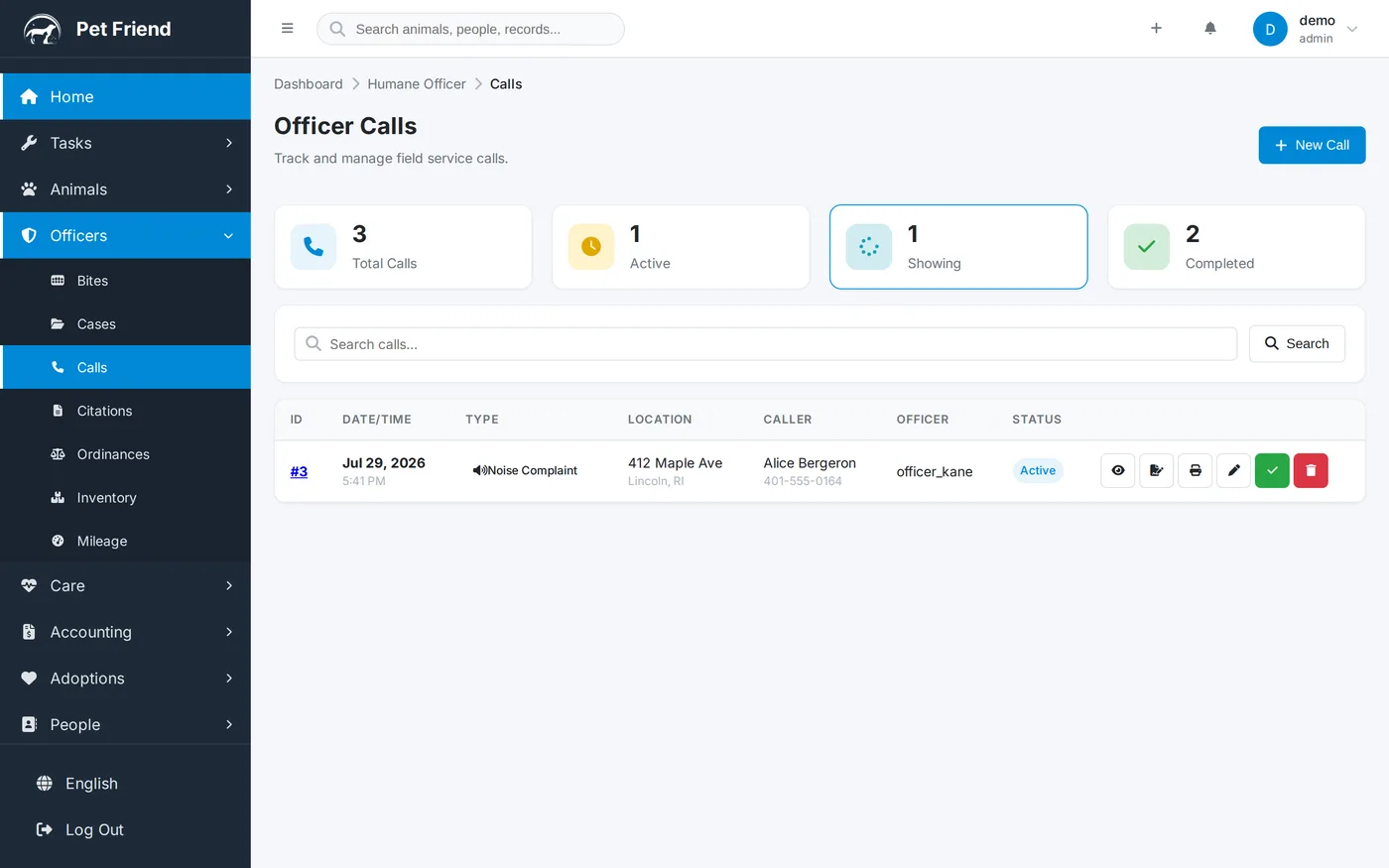
Calls, cases, and citations that know about each other
Nearly every significant matter starts as a call, becomes a case, and produces a citation. In most agencies those three live in three separate places, so when the same address calls for the fourth time nobody can see that it's the fourth time.
From the case, everything attached to it is visible in one place, and you can issue a citation, log another call, or start a bite report that all arrive already linked back to it.
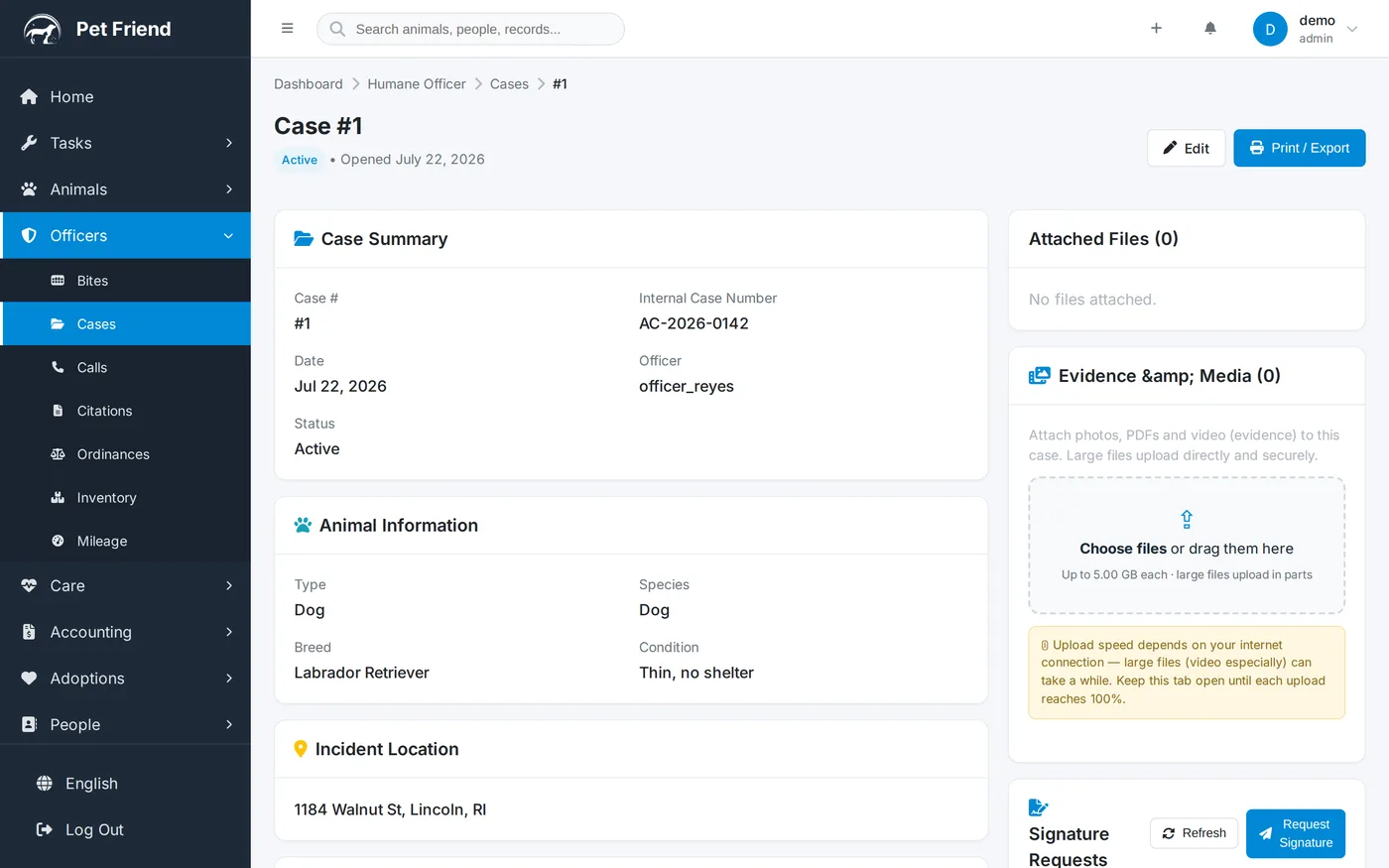
Every link is optional and uses a quick search — type a name, an address, or #12 and pick from the list. Links show in both directions, so opening the citation shows its case, and opening the case shows its citations.
Bite reports, including the animal you've never seen
Bite investigations are where sloppy records turn into a public-health problem. Pet Friend records the victim, the rabies status, and calculates the quarantine end date from the date of the bite — not the date the report was filed.
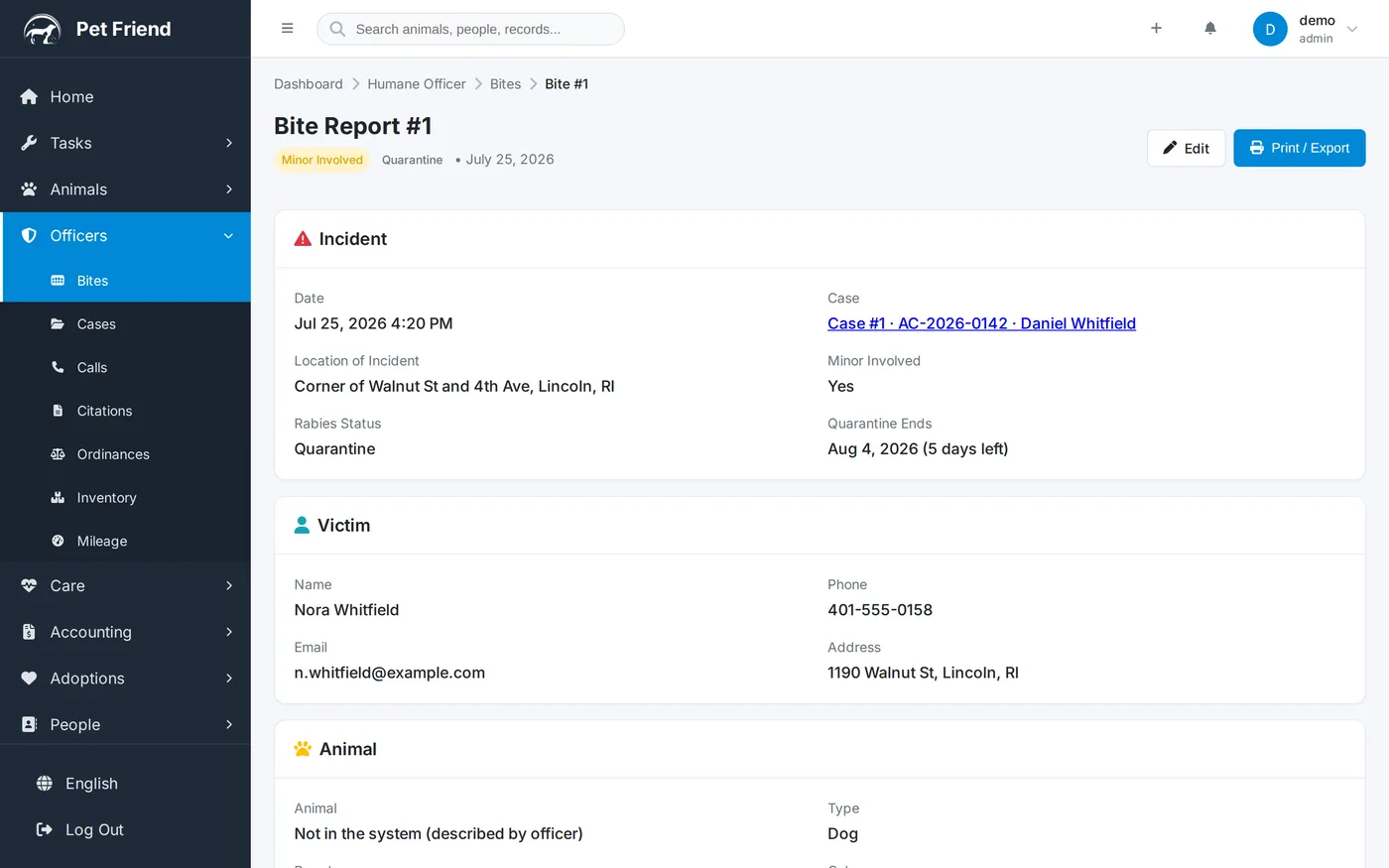
The victim can be sent the bite report to review and sign the same way a citation is sent, and receives the same receipt with their signed copy.
The numbers you defend your budget with
Animal control budgets are argued with numbers that usually have to be reconstructed by hand. These are available continuously instead.
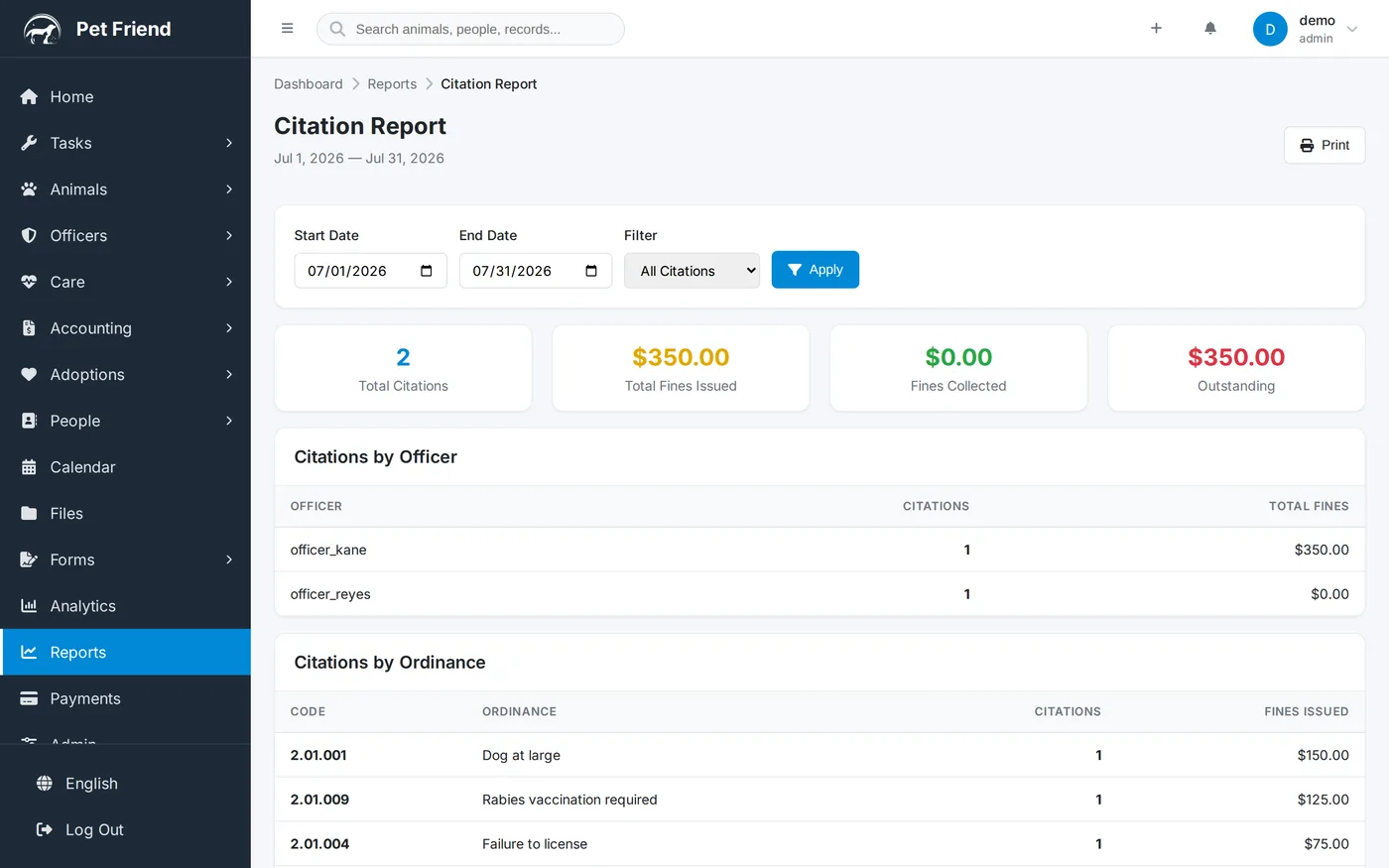
- Citations by ordinance — which violations you're really writing.
- Unpaid fines with aging — what your city attorney needs to pursue collections, not just a total.
- Officer activity — calls handled, citations written, and fines issued per officer.
- Bite investigations — volume and quarantine status.
Everything else an agency runs
The officer module sits inside full shelter software, which matters if your agency also runs the shelter the animals arrive at: intake, medical and vaccination records, kennels, adoptions and returns, licensing, equipment inventory, and officer mileage. It runs on a phone in the truck as well as a desktop, and every address field suggests real addresses as you type.
Try it with your own ordinances.
Pet Friend's animal control tools are part of the Shelter Plus plan — a flat $100/month, with no per-officer fees.
Open the live demoAnimal control software FAQ
What does animal control software need that shelter software does not?
Field work. An ordinance library with pre-set fines, citations that can carry several ordinances at once, calls that escalate into cases, bite investigations for animals that were never impounded, and a way to get an acknowledgment signed at the scene. Shelter software is built around animals you have taken in; animal control spends most of its day on animals it has not.
Can Pet Friend put more than one ordinance on a single citation?
Yes. Add as many ordinances as the incident violated, each with its own fine and its own wording that you can adjust for that specific call. The total fine adds itself up, and the printed citation and the notice the offender signs both list every ordinance with its description.
How does an offender sign an animal control citation remotely?
The officer clicks Request Signature on the citation — from the list or the record — and Pet Friend builds the notice automatically from the ordinances on that citation. It goes out by email or text, or the officer hands over their own device. When the person signs, they are emailed or texted a receipt with a link to download their signed copy.
Does Pet Friend send a receipt when a fine is paid?
Yes. Marking a citation paid sends the offender a payment receipt itemized by ordinance, by email or text, provided their contact details are on the citation. Paid citations keep a one-click resend button.
Can a bite report be filed for an animal that is not in our system?
Yes, and that is the common case. The officer can pick an animal from your records or simply describe the animal — type, breed, and colour — as structured data. The report also records the location of the incident separately from the victim's home address.
How much does Pet Friend animal control software cost?
The animal control officer module is part of the Shelter Plus plan at $100 per month, billed flat with no per-user or per-officer fees. Yearly billing with purchase orders and check payment is available for municipal procurement.
Related reading
See the full animal control software page, or the field guide to writing citations that hold up. Working for a city or county? See municipal shelter software. Pet Friend is also complete animal shelter software — see the intake process and how to choose shelter software.